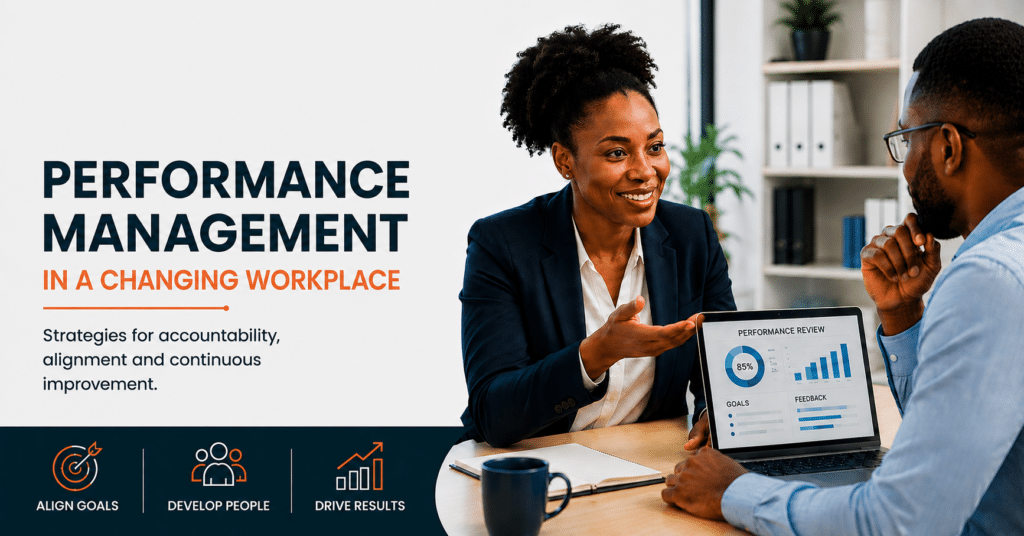
Sustained performance is rarely the result of talent alone. It is shaped by the quality of leadership, the clarity of expectations, the frequency of meaningful feedback, and the opportunities employees have to improve over time. Organizations that consistently maintain good performance understand that high performance is not an event to be measured periodically, it is a capability that must be developed continuously.
This perspective has fundamentally changed the role of performance management. Once viewed primarily as a process for evaluating employee performance, it is increasingly recognized as a strategic system for maintaining alignment, strengthening accountability, and enabling continuous improvement across the organization. Rather than replacing annual appraisals, modern performance management builds upon them.
It recognizes that while formal reviews remain valuable, they represent only one component of a broader performance system. Organizations achieve stronger results when performance is supported through regular conversations, timely feedback, continuous coaching, and clear alignment between individual contributions and organizational objectives.
Performance Management as a Driver of Organizational Alignment
Every organization develops strategies intended to guide growth, improve performance, and create long-term value. Achieving these ambitions, however, depends not only on the quality of the strategy itself but also on how effectively it is translated into everyday work and if employees are clear about priorities and how their individual responsibilities contribute to broader organizational goals.
Performance management plays a critical role in creating this alignment. It provides a structured framework through which organizational objectives are communicated, individual expectations are clarified, and progress is reviewed consistently. Rather than functioning solely as a tool for evaluating employee performance, it helps ensure that the work employees perform every day remains connected to the direction the organization intends to take.
This alignment becomes increasingly important as organizations grow or operate in rapidly changing environments. Performance management enables organizations to respond to these changes by creating regular opportunities to revisit priorities, adjust goals where necessary, and maintain focus on outcomes that create the greatest organizational value.
For employees, this clarity creates a stronger sense of purpose and direction. Understanding how individual contributions support organizational success encourages greater ownership, improves decision-making, and reinforces accountability. For leaders, it creates greater confidence that teams are working toward common objectives rather than pursuing disconnected priorities.
When performance management continuously reinforces organizational alignment, it becomes more than an employee management process. It becomes a strategic mechanism for ensuring that business strategy is consistently translated into execution across every level of the organization.
Continuous Conversations Create Stronger Performance
Performance is rarely improved by evaluation alone. It improves through regular communication, timely guidance, and meaningful conversations that help employees understand where they are succeeding and where further development is needed.
Continuous performance conversations encourage a more proactive approach for managers and employees to engage in regular discussions that review progress, address emerging challenges, recognize achievements, and identify practical opportunities for improvement.
These conversations also strengthen communication between managers and employees. Employees gain greater confidence because expectations remain clear, while managers develop a deeper understanding of the support, resources, and guidance their teams require to perform effectively.
Likewise, constructive feedback becomes more effective when employees can immediately apply it to their work. This ongoing exchange helps create an environment where feedback is viewed as an essential part of professional growth rather than simply an assessment of past performance.
Leadership Shapes the Performance Experience
The effectiveness of performance management is influenced as much by leadership behaviour as by the framework itself. Managers play a central role in shaping how employees experience performance management. They communicate expectations, provide guidance, recognize achievement, address challenges, and create opportunities for employees to grow.
Every interaction contributes to how employees perceive performance conversations and whether those conversations motivate improvement or become routine compliance activities.
Increasingly, organizations are encouraging managers to adopt a coaching mindset alongside their management responsibilities. Coaching focuses on helping employees build capability, overcome challenges, and reach higher levels of performance through continuous support and constructive dialogue.
Coaching encourages managers to ask questions, provide guidance, and create opportunities for learning through everyday work.
This approach strengthens trust between managers and employees while encouraging greater openness during performance discussions. Employees become more willing to seek feedback, discuss challenges, and explore development opportunities because conversations are centred on improvement rather than judgment alone.
Performance Management Supports Organizational Agility
By creating regular opportunities to review objectives, discuss progress, and address emerging priorities, organizations are able to maintain alignment without waiting for formal review periods.
Employees gain a clearer understanding of changing expectations, while managers are better positioned to provide guidance that reflects current business needs.
This responsiveness enables organizations to make adjustments with greater confidence. Teams remain focused on delivering outcomes that support organizational priorities, even as those priorities evolve.
Rather than viewing performance management as a fixed annual process, organizations increasingly use it as a flexible management tool that helps maintain momentum in dynamic business environments.
As a result, performance management contributes not only to individual performance but also to the organization’s ability to adapt, respond, and remain competitive in an increasingly complex marketplace.
Building Accountability Through Clarity
Accountability thrives when employees understand what is expected of them and how their responsibilities contribute to broader organizational goals.
Through ongoing goal setting, regular feedback, and continuous communication, employees gain a stronger understanding of their responsibilities and the standards against which their performance is assessed.
Managers likewise have greater opportunities to clarify expectations, address uncertainties, and reinforce priorities before misunderstandings affect performance.
This shared understanding creates a stronger sense of ownership across teams. Employees are better equipped to take responsibility for their work because expectations remain visible and consistent rather than being revisited only during formal review periods.
Managers also benefit from more balanced and objective performance discussions because they are informed by continuous observation rather than isolated events.
When accountability is supported by clarity rather than uncertainty, organizations create environments where employees are empowered to perform with confidence while remaining aligned with organizational objectives.
Creating a Culture of Continuous Improvement
Sustainable organizational performance is built through cultures where learning, feedback, and improvement become part of everyday work.
Performance management contributes significantly to this culture by encouraging regular dialogue between managers and employees.
Employees become more comfortable seeking guidance, discussing challenges, and identifying opportunities to strengthen their performance because feedback is positioned as a normal part of professional development.
Managers likewise become more proactive in recognizing achievements, providing coaching, and supporting employee growth as part of their day-to-day leadership responsibilities.
Over time, these behaviours reinforce a culture where improvement is continuous rather than occasional. Employees remain engaged because they receive consistent support, while organizations benefit from stronger collaboration, greater innovation, and a workforce that is committed to ongoing development.
Such cultures are often better equipped to navigate change because continuous learning becomes embedded within the organization rather than introduced only when new challenges emerge.
Performance Management as a Strategic Business Capability
When performance management is integrated into everyday leadership practices, it supports far more than employee evaluation.
It strengthens communication, reinforces organizational priorities, develops leadership capability, and creates stronger alignment between individual contributions and strategic objectives.
This broader perspective also encourages organizations to view performance management as a long-term investment rather than a periodic administrative requirement.
Every meaningful performance conversation contributes to stronger relationships, improved capability, and more informed decision-making.
Collectively, these conversations create a workforce that is better prepared to achieve organizational goals while adapting to future business challenges.
Annual appraisals continue to provide important opportunities for formal evaluation and reflection. However, they deliver the greatest value when they form part of a continuous performance management framework that supports employees throughout the year.
Organizations that embrace this approach are better positioned to build high-performing teams, develop future leaders, and sustain long-term organizational success.
Partner with Dira HR Solutions
Effective performance management requires more than performance review templates or scheduled appraisal meetings. It requires a structured framework that aligns leadership practices, employee development, organizational objectives, and continuous feedback into a system that supports both individual and business performance.
Dira HR Solutions partners with organizations to design and implement strategic performance management frameworks that strengthen organizational alignment, improve leadership effectiveness, and support continuous employee development.
Through practical HR consultancy, Dira HR Solutions helps organizations build systems that encourage meaningful performance conversations, strengthen managerial capability, and create clear connections between employee performance and organizational strategy.
By moving beyond compliance-driven performance processes, organizations can establish performance management systems that improve accountability, strengthen employee engagement, and build the capability needed to support long-term organizational growth.
Partner with Dira HR Solutions
Organizations achieve stronger and more sustainable results when performance management becomes an ongoing leadership practice rather than an annual administrative exercise.
Building such a system requires clear frameworks, capable leaders, and a commitment to continuous improvement across every level of the organization.
Partner with Dira HR Solutions to design and implement a strategic performance management framework that strengthens organizational alignment, develops leadership capability, and empowers employees to perform at their highest potential while supporting long-term business success.