Sustainable organizational success depends just as much on how people are developed once they become part of the workforce. This is where performance management takes on a far more strategic role than many organizations traditionally assign to it.
Performance management has been closely associated with appraisals, ratings, and end-of-year evaluations. While these remain important elements of managing performance, they represent only a small part of what effective performance management can achieve. One of the greatest opportunities performance management provides is the ability to develop capability, strengthen engagement, and prepare employees for future responsibilities.
Continuous growth has become a business necessity rather than an employee benefit. Performance management provides the structure through which this growth can happen consistently, intentionally, and in alignment with organizational objectives. When viewed through this broader perspective, performance management becomes less about measuring past performance and more about enabling future success.
Development Should Be the Centre of Performance Management
While evaluating performance remains important, assessment alone rarely improves future performance. Employees grow when they receive guidance, constructive feedback, opportunities to learn, and support in developing new skills. Without these elements, performance management risks becoming an administrative exercise instead of a meaningful driver of improvement.
A development-focused approach shifts the purpose of performance management. Instead of asking only how employees performed, organizations also consider how employees can continue building the knowledge, competencies, and confidence required to succeed in increasingly complex roles. This perspective encourages organizations to view performance management as an ongoing investment in people rather than a periodic assessment of results.
Better Conversations Create Better Performance
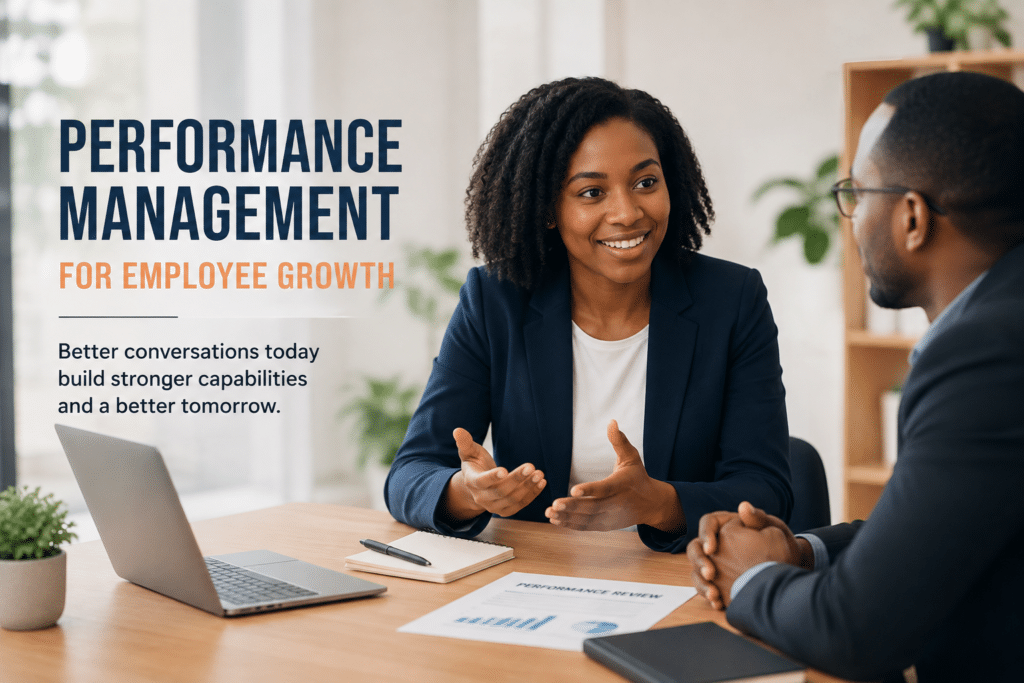
The quality of performance management is often determined by the quality of conversations taking place between managers and employees. Employees benefit from regular discussions that provide clarity on expectations, recognize achievements, explore challenges, and identify opportunities for improvement. These conversations create an environment where feedback is viewed as support rather than criticism, making employees more willing to learn and adapt.
For managers, regular performance discussions provide valuable insight into employee strengths, development needs, and career ambitions. Rather than waiting for formal review periods, managers can address concerns early, celebrate progress, and provide coaching when it is most valuable.
Meaningful conversations also strengthen trust. Employees who feel heard and supported are more likely to remain engaged, take ownership of their work, and contribute positively to team performance. Over time, organizations that encourage continuous dialogue create stronger relationships between managers and employees, leading to higher levels of collaboration, accountability, and performance.
Learning That Keeps Pace With Changing Work
Performance management provides a structured way of identifying emerging capability needs before they become performance challenges. Regular discussions allow managers and employees to identify skill gaps, explore learning opportunities, and create development plans that reflect both individual career aspirations and organizational priorities. This proactive approach ensures learning remains relevant rather than reactive.
Development activities may include formal training, mentoring, coaching, stretch assignments, cross-functional collaboration, or increased responsibility within existing roles. Regardless of the approach, the objective remains the same: helping employees continuously strengthen their ability to contribute effectively.
Organizations that embed learning into performance management create workforces that are more adaptable, resilient, and prepared to respond to future business demands.
Career Growth Becomes Shared Responsibility
Rather than limiting conversations to current performance, managers can explore employees’ long-term aspirations, identify areas for growth, and discuss the experiences required to prepare for future opportunities. This approach transforms career development into a shared responsibility. Employees take ownership of their professional growth while organizations provide the guidance, opportunities, and support needed to help them progress.
When employees understand how their development aligns with future organizational opportunities, motivation often increases. They are better able to see how continuous learning contributes not only to individual success but also to the organization’s long-term goals. Organizations also benefit from stronger internal talent pipelines, reducing reliance on external recruitment for leadership and specialist positions.
Managers Shape More Than Performance
The effectiveness of any performance management system depends largely on the role managers play within it. Managers who coach rather than simply assess create environments where employees feel supported in solving problems, building confidence, and improving their capabilities. They encourage reflection, provide constructive guidance, and create opportunities for learning through everyday work.
This coaching mindset changes the nature of performance management. Employees become active participants in their own development rather than passive recipients of performance ratings. As managers strengthen their coaching capability, organizations often experience improvements in employee engagement, collaboration, innovation, and overall team effectiveness.
Employee Growth Strengthens Organizational Capability
Every improvement in employee knowledge, technical expertise, leadership ability, communication, or problem-solving capacity contributes directly to the organization’s ability to achieve its objectives. As employees grow, organizations become better equipped to respond to market changes, improve customer service, adopt new technologies, and pursue innovation.
Teams become more capable of working collaboratively because individuals possess greater confidence and competence in their roles.
Performance management therefore serves a much broader organizational purpose than simply monitoring productivity. It creates a continuous cycle of learning and improvement that strengthens the organization over time. Rather than viewing development initiatives as separate from business strategy, organizations increasingly integrate performance management into broader workforce planning, leadership development, succession planning, and organizational capability building.
This alignment ensures that employee growth contributes directly to long-term organizational performance.
Building a Culture Where Growth Is Continuous
The greatest value of performance management lies not in its ability to measure performance but in its ability to improve it. Organizations that view performance management as a strategic investment recognize that every performance conversation is an opportunity to strengthen capability, develop future leaders, and improve organizational effectiveness.
By creating systems that prioritize continuous development rather than periodic evaluation alone, organizations position themselves to retain talented employees, strengthen workforce capability, and build sustainable competitive advantage. Performance management therefore becomes more than an HR process. It becomes a business strategy for developing the people who drive organizational success.
Performance Management as a Strategic Investment
The greatest value of performance management lies not in its ability to measure performance but in its ability to improve it. Organizations that view performance management as a strategic investment recognize that every performance conversation is an opportunity to strengthen capability, develop future leaders, and improve organizational effectiveness.
By creating systems that prioritize continuous development rather than periodic evaluation alone, organizations position themselves to retain talented employees, strengthen workforce capability, and build sustainable competitive advantage. Performance management therefore becomes more than an HR process. It becomes a business strategy for developing the people who drive organizational success.
Strategic Performance Management with Dira HR
Designing an effective performance management system requires more than appraisal forms and performance ratings. It requires a structured framework that supports continuous development, meaningful feedback, managerial capability, and alignment between employee growth and organizational strategy.
Dira HR Solutions partners with organizations to develop performance management systems that move beyond traditional evaluation and create environments where employees continuously learn, improve, and contribute to organizational success.
Through strategic HR consultancy, Dira HR Solutions supports organizations in designing performance frameworks, strengthening managerial coaching capability, integrating employee development into performance processes, and aligning performance management with broader workforce and business objectives.
By placing employee growth at the centre of performance management, organizations build stronger teams, develop future leaders, and create workplaces equipped for long-term success.
Partner with Dira HR Solutions
Investing in employee growth is one of the most effective ways to strengthen organizational performance. A well-designed performance management system helps employees build capability, supports career development, and creates a culture of continuous improvement that benefits the entire organization.
Partner with Dira HR Solutions to design and implement a strategic performance management framework that develops people, strengthens organizational capability, and supports sustainable business growth.